


Commercial Preventive Maintenance
Commercial Plumbing Preventive Maintenance in San Diego
Know your building. Track what matters. Stay ahead of what repeats.
Pacific Standard Plumbing builds property-specific commercial plumbing maintenance programs for commercial buildings, HOAs, hospitality, healthcare, multifamily, restaurants, and professionally managed properties throughout San Diego County.
- Property-Specific Plans
- Scheduled Service
- Documented Findings
- Commercial Only
Get Out of Reactive Mode
A Building Shouldn’t Have to Rely on Someone’s Memory.
Every commercial property develops a plumbing history.
- The drain that backs up twice a year.
- The aging water heater.
- The valve that needs replacement.
- The annual backflow deadline.
- The lift station that only gets attention when the alarm comes on.
- The line that needs recurring jetting.
The problem is that this information often ends up scattered across old invoices, work orders, emails, technician notes, and people’s heads.
Pacific Standard Plumbing brings the recurring work, known conditions, service history, and next steps together into a maintenance plan built around the property.
Built Around Your Property
Your Property Plumbing Plan.
Preventive maintenance should be more than a technician showing up every few months with the same checklist.
It should give your team a working picture of the building.
What You Have
The plumbing systems, equipment, critical components, and known problem areas that matter to the property.
What Needs Recurring Service
The systems and requirements that need to happen again—drain maintenance, backflow testing, pump inspections, hot-water service, kitchen lines, or whatever actually belongs on the schedule.
What Condition It’s In
What is operating normally, what needs attention, what should be planned, and what is worth monitoring.
What Happens Next
Upcoming inspections, maintenance, testing, repairs, follow-up, and known future needs.
The goal is simple: the building should become easier to manage the longer we work on it.
Start With the Building
We Don’t Start With a Template.
A hotel should not have the same maintenance plan as an office building.
A restaurant should not be maintained like an HOA.
Two properties built twenty years apart should not automatically be put on the same schedule.
So we start with the property itself.
1. Walk the Property
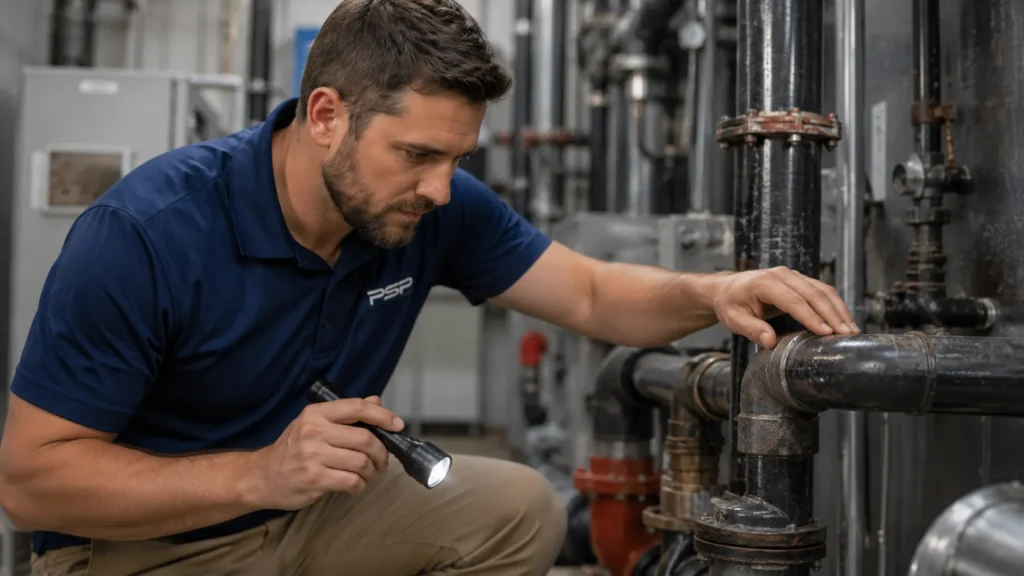
Review the building, plumbing systems, equipment, known trouble areas, recurring calls, and operational concerns with your team.
2. Identify What Matters
Separate the systems that need recurring attention from the things that do not belong on a maintenance schedule.
3. Build the Plan
Recommend the inspections and recurring services that make sense for the actual building.
4. Set the Schedule
Monthly, quarterly, semiannual, annual, or condition-based depending on the system and need.
5. Document the Work
Keep a useful record of what was serviced, what changed, what was found, and what happens next.
What matters goes on the plan. What doesn’t, doesn’t.
Building Knowledge
Every Service Call Should Add to the Building’s History.
A good maintenance relationship gets more useful over time.
The first visit teaches us the property. The next visit shows us what changed. Recurring service reveals patterns. Repairs show us which components are aging. Inspection history helps separate one-time problems from recurring ones.
The next technician should not have to rediscover everything the last technician already learned.
Every visit should make the next visit smarter.
We don’t just maintain the property. We learn it.

Recurring Work, Organized
If It Keeps Happening, Has a Deadline, or Matters Too Much to Forget, It Probably Belongs on the Plan.
Depending on the property, a Pacific Standard Plumbing maintenance program may include:
Drains & Sewers
Recurring drain cleaning, hydro jetting, camera inspection, and service for lines with a history of buildup, stoppages, or heavy use.
Water Heaters & Boilers
Scheduled inspection and applicable maintenance for commercial hot-water systems and related equipment.
Backflow
Annual testing, repairs, retesting, and recurring compliance service for applicable backflow prevention assemblies.
Lift Stations & Sewage Ejectors
Inspection of applicable pumps, floats, valves, alarms, and wastewater pumping systems.
Commercial Kitchen Plumbing
Scheduled grease-line, drain, and interceptor-plumbing service for kitchens where recurring buildup can disrupt operations.
Shutoff Valves & Critical Components
Inspection of accessible valves and plumbing components you need to work when the property actually needs them.
Restrooms & Fixtures
Inspection of high-use toilets, urinals, flush valves, faucets, and recurring fixture issues.
Leaks & Water Pressure
Checks for visible leaks, abnormal operating conditions, and pressure-related issues affecting the plumbing system.
No maintenance for maintenance’s sake. If it does not make sense for the property, it does not belong on the plan.
Clearer Decisions
Not Everything Needs to Be Fixed Today.
A useful maintenance program does not turn every observation into a repair.
It helps your team understand what actually deserves attention.
Needs Action
Address
Active failures, developing leaks, malfunctioning equipment, serious restrictions, or conditions that should be addressed now.
Not Urgent Today, But Worth Scheduling
Plan
Aging equipment, worn components, recurring issues, and work that belongs on the calendar or in the budget.
No Work Required Today
Monitor
Conditions worth documenting and checking again before they become something larger.
Good maintenance isn’t finding more things to sell. It’s knowing what actually deserves attention.
Documented Closeout
You Should Know More About the Building Than You Did Before.
A scheduled maintenance visit should produce more than an invoice.
Your team should have a clear record of:
What We Inspected
The systems and equipment reviewed.
What We Serviced
The recurring maintenance completed.
What We Found
Relevant conditions, changes, and observations.
What Needs Attention
Items requiring action or repair.
What Should Be Planned
Work that should be scheduled or budgeted.
What We’re Watching
Conditions that do not require action today but should stay on the radar.
What Comes Next
The next scheduled service, inspection, test, or follow-up item.
Know what needs attention. Know what can wait. Know what comes next.
Control the Timing
Planned Work Gives You Options.
Emergencies take them away.
Reactive
- The drain is already backed up.
- The tenant is already affected.
- The pump alarm is already sounding.
- The hot water is already down.
- The technician is already on site.
- The repair is now urgent.
Planned
- The condition is identified earlier.
- Access can be coordinated.
- Tenants can be notified.
- Shutdowns can be scheduled.
- Approvals can happen ahead of time.
- The work can happen around the property.
Preventive maintenance will not eliminate every unexpected failure.
It can help turn more plumbing work from reactive into planned.
For the People Responsible for the Property
Less to Remember. More to Know.
You shouldn’t have to remember when the backflow test is due. Or which drain keeps slowing down. Or when the lift station was last inspected. Or whether that valve was supposed to be checked again. Or what PSP recommended six months ago.
That’s what the program is for.
Recurring Service
Put work that repeats on an actual schedule.
Property History
Build a useful record of what was inspected, serviced, repaired, replaced, and recommended.
Clear Priorities
Separate what needs action from what should be planned and what simply needs to be watched.
Documented Closeout
Know what happened after each visit and what comes next.
The property manager shouldn’t have to remember the plumbing. The program should.
One Property or an Entire Portfolio
One Standard. Property-Specific Plans.
Managing recurring plumbing across multiple buildings gets complicated quickly.
Different properties have different systems, equipment, service histories, access requirements, and recurring problems.
Pacific Standard Plumbing can coordinate preventive maintenance across a portfolio while keeping the plan specific to each building.
Coordinated Scheduling
Group recurring service where practical and reduce one-off scheduling.
Consistent Process
Use the same approach to inspection, prioritization, documentation, and closeout across the portfolio.
Property-Specific Records
Maintain service history, recurring requirements, and known conditions by building.
One Point of Contact
Give your team one commercial plumbing partner for recurring service across managed properties.
One property. Ten properties. Fifty properties. Same standard.
Different Properties. Different Priorities.
The Plan Should Match the Building.
HOA & Multifamily
Common-area drainage, hot-water systems, backflow, pumps, shutoff valves, and plumbing problems that can affect multiple residents.
Hotels & Hospitality
Hot water, commercial kitchens, public restrooms, high-use drains, pumps, and plumbing systems operating around the clock.
Restaurants & Commercial Kitchens
Grease-prone waste lines, recurring drain maintenance, hot water, and plumbing where downtime directly affects operations.
Healthcare & Senior Living
High-use systems where reliability, documentation, coordination, and minimizing disruption matter every day.
Office, Retail & Commercial
Restrooms, drainage, hot water, backflow, leaks, valves, and infrastructure tenants expect to work without thinking about it.
FAQ
Commercial Plumbing Preventive Maintenance FAQs
What is a commercial plumbing preventive maintenance program?
A property-specific plan for recurring plumbing inspections, service, and documentation built around the building’s systems, operating conditions, service history, and priorities.
What is a Property Plumbing Plan?
It is the working record behind the maintenance program.
It identifies the important plumbing systems at the property, recurring service needs, known conditions, priorities, service history, and upcoming maintenance or follow-up.
What can be included?
Depending on the property, the plan may include drain and sewer maintenance, hydro jetting, water heaters and boilers, backflow testing, lift stations, commercial kitchen plumbing, valves, fixtures, leak checks, and other recurring plumbing needs.
How often will service be scheduled?
There is no single schedule that fits every building.
Some systems may need monthly or quarterly attention. Others may be semiannual, annual, or condition-based.
The schedule should reflect the actual property, equipment, usage, history, and consequences of failure.
Does preventive maintenance guarantee we won’t have emergencies?
No.
Plumbing systems can fail unexpectedly.
The goal is to identify more developing problems earlier, keep recurring work from being forgotten, maintain better records, and reduce the number of problems that become urgent simply because nobody knew they were developing.
What happens if you find something?
We document the condition, explain what we found, and identify the appropriate next step.
Additional repair work is discussed and authorized before proceeding unless another approval process has been established with your team.
Do we need to know what should be included before calling?
No.
Start with the property walkthrough.
We’ll review the building, known problems, applicable systems, and service history with your team and identify what is actually worth putting on a schedule.
Can you manage multiple properties?
Yes. Pacific Standard Plumbing can coordinate preventive maintenance across multiple managed properties while keeping each building’s scope, schedule, and service history specific to that property.
Can you work around tenants and business hours?
Yes.
Access, tenant coordination, operating hours, shutdown requirements, and property procedures are part of commercial service.
Areas we Serve
Don’t see your Area listed? Give us a call!

San Diego County
Preventive Maintenance for Commercial Properties Across San Diego County.
From our Santee shop, Pacific Standard Plumbing provides commercial plumbing preventive maintenance for properties throughout San Diego County.

Start With the Property
Build Your Property Plumbing Plan.
Show us the building. Tell us what keeps happening. Tell us what gets forgotten. Tell us what creates the most disruption. Tell us what your team never wants to deal with as an emergency.
We’ll identify the systems worth tracking, the recurring work worth scheduling, and the plumbing problems worth getting ahead of.
Call 858.255.1654 or use the form to start with a property walkthrough.
The more we know about your building, the better we can take care of it.